-
Find your fit
Let’s find the right tire for you.
-
Browse tires by
- Vehicle Type
-
Product Line
- Tire Use
Reading a Sidewall
previous
next


Width & Tire Type
The width indicates the widest point of a tire from sidewall to sidewall. Some tires have a P or LT in front of the tire width, identifying them for passenger or light truck use.
Aspect Ratio And Radial Construction
The aspect ratio is the dimensional relationship of the section height to the section width. Tires with an "R" indicate radial tire construction.
Load Index, Speed Symbol, & Diameter
The load index number and speed symbol correspond to the maximum load-carrying capacity of the tire and its maximum speed capability. The diameter is the size of the wheel from one side to the other.
DOT Tire ID Number
The DOT tire identification number indicates compliance with all safety standards established by the U.S. Department of Transportation and provides additional information about the tire manufacturer.
Treadwear, Traction, & Temperature Grades
The UTQG code provides consumers with information on tire treadwear, traction, and operating temperature resistance.
Mud, Snow, & Severe Snow Tires
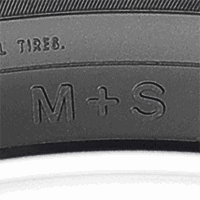
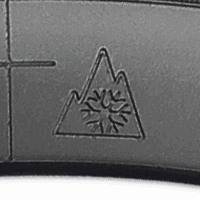
M+S designates a mud and snow tire. The mountain/snowflake designate a tire designed for severe snow conditions.
About the Sidewall
The sidewall of a tire includes a variety of important information. The numbers and letters identify dimensions and performance standards that allow you to compare tires more accurately and efficiently. The diagrams above will help you to understand those numbers and letters. For assistance in selecting a replacement tire, always consult your Toyo Tires dealer.
LOAD INDEX
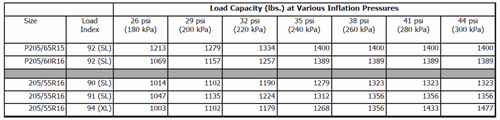
The load index and speed rating correspond to the maximum load-carrying capacity of the tire and its maximum speed capability. The load index is a numerical code associated with the maximum load a tire can carry at the speed indicated by the tire's speed symbol under certain specified service conditions. When replacing tires on your vehicle, you should use replacement tires that meet or exceed the load carrying capacity of the original equipment (O.E.) tires.
Check the tire size, load index and speed symbol on the vehicle's tire placard. The load index may not be used independently to determine replacement tire acceptability for load capacity. An equal or greater load index does not always correspond to equal or greater capacity at all inflation pressure settings, particularly when comparing P-metric and metric passenger car tires.
Click here to view the complete load inflation index.
Examples of Tire Size and Load Index Value Differences
SPEED RATING
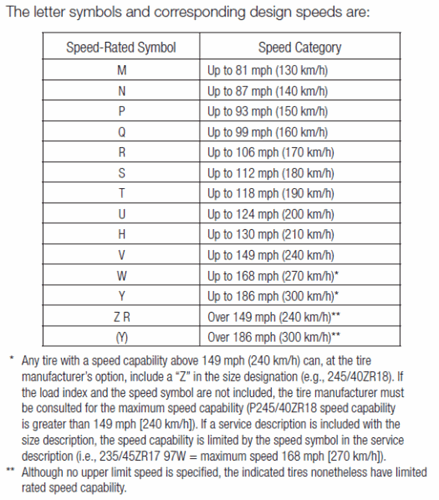
Speed ratings are determined by indoor laboratory testing methods, which measure high-speed tire durability under controlled test conditions. These test procedures do not take into account underinflation, tire damage, vehicle characteristics or road conditions which can lead to sudden tire failure or loss of vehicle control at much lower speeds than indicated by the tire's speed rating.
When replacing tires on your vehicle, you should use replacement tires with a speed rating equal to or greater than that of the original equipment tires if the speed capability and handling characteristics of the vehicle are to be maintained. Remember to never operate your vehicle in an unsafe or unlawful manner. Your Toyo Tires dealer can provide you with more information on speed ratings.
DIAMETER
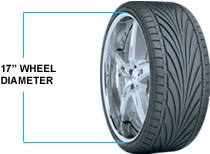
The diameter indicates the size of the wheel from one side to the other. You can learn more about changing the diameter of the wheels of your car in the Plus Sizing section.
RADIAL
The "R" stands for "radial," indicating the tire has radial construction.
ASPECT RATIO
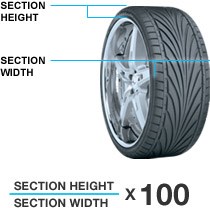
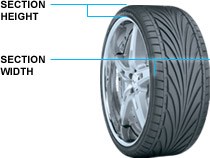
The aspect ratio is the dimensional relationship of the section height to the section width. The lower the aspect ratio, the shorter the sidewall and the wider the shoulder-to-shoulder width.
WIDTH
The width of a tire is referred to as its section width. This is the width of an inflated tire in millimeters at its widest point from sidewall to sidewall.
The section height of the tire is measured in millimeters also. The section height is approximately the distance from the rim to the tread surface of the tire when it is not carrying any weight.
TIRE TYPE
Tires with a “P” are for passenger car use. Some passenger car tires may not have a “P” and are considered hard-metric tires. Some light trucks and SUV’s are equipped with original equipment P-metric or hard-metric tires.
Tires with a “LT” are for light truck or SUV use only. The "LT" designation stands for "Light Truck." These tires are intended for more severe use often seen on trucks and follow load and inflation standards established by the Tire and Rim Association (TRA). Load Index values and load capacities for these tires can be found in TRA manuals.
Other Designations
Mud and Snow
The "M+S" indicates the tire is designed for mud and snow applications. The Mud and Snow designation may also appear as "M&S" or "M/S."
 Mountain Snowflake
The mountain/snowflake designate a tire designed for severe snow conditions.
TREADWEAR, TRACTION, AND TEMPERATURE GRADES
Uniform Tire Quality Grading:
The Uniform Tire Quality Grading System, or UTQG, is a system developed by the government designed to provide consumers with information on tire treadwear, traction, and operating temperature resistance. A number, followed by two to three letters, identifies the grade on the sidewall.
Treadwear Rating:
The treadwear grade is a comparative numerical rating based on the wear rate of the tire when tested under controlled conditions on a specified government test course. For example, a tire graded 200 would wear twice as well on the course as a tire graded 100. The rating increases in 20-point increments. It is important to note that the true performance of a tire depends upon the actual conditions of its use. Actual conditions may depart significantly from the test conditions due to variations in driving habits, service practices and differences in road characteristics and climates.
Traction Rating:
The traction rating indicates the tire's ability to stop a vehicle moving straight forward on wet pavement. The ratings are AA, A, B, and C, with AA being the best.
Temperature Rating:
The UTQG Temperature Rating indicates the tire's ability to effectively dissipate heat. The ratings range from A to C, with A being the best.
U.S. DOT TIRE STANDARD SAFETY CODE
The DOT tire identification number indicates compliance with all safety standards established by the U.S. Department of Transportation and provides additional information about the tire manufacturer.
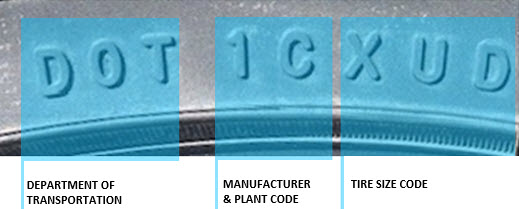
Located on the sidewall of a tire, the complete DOT tire identification number is a combination of up to 13 numbers and letters that provide valuable information.
- The first two numbers or letters are the plant code where the tire was manufactured.
- The last three to four numbers represent the week and year the tire was built. The last four digits in this example, 2623, mean this tire was manufactured in the 26th week of 2023.
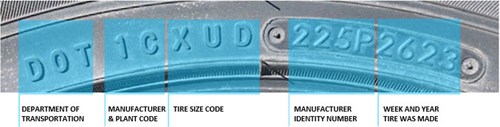
Recently it became mandatory to apply a partial DOT serial number on the sidewall opposite the complete DOT serial number. The partial DOT serial shows manufacturer, plant and tire size information. It does not show the week and year that the tire was manufactured, but may still assist consumers in identifying tires should a recall be necessary. The purpose in applying the partial DOT serial number was to facilitate tire identification when the full DOT serial number may have been mounted towards the inboard side of the vehicle, and consequently not visible unless the vehicle was put on a lift for inspection.
This is the partial DOT number for the full DOT number show above.
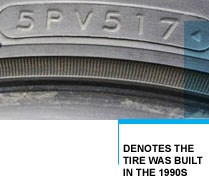
Tires built in the 1990's will have three numbers and may have a triangle to note the decade. The last three digits, 517, plus the triangle in the example above mean this tire was manufactured in the 51st week of 1997. In the absence of the decade triangle, this tire would have been made during the 51st week of 1987.
For assistance in reading your DOT tire identification number, please contact us.